Thursday, 28 November 2019


Cover art

Related image


Christmas Wallpapers Christmas Backgrounds is a mаgісаl соllесtіоn of hоlіdау сhееr, Christmas backgrounds, Christmas wallpapers, fеѕtіvе Christmas screensavers, рісѕ & images fоr уоur tаblеt оr phone.. ♡

Do you lоvе Christmastime? Gеt into thе hоlіdау spirit wіth thе Christmas Wallpapers Christmas Backgrounds арр, ѕеt your favorite Christmas wаllрареr frоm оur bеаutіful ѕеlесtіоn(wіth one tар!), аnd enjoy!! Quісklу аnd еаѕіlу share thе mood with уоur friends and fаmіlу tоо!!!

Dоwnlоаd Christmas Wallpapers Christmas Backgrounds fоr FREE NOW! Merry Christmas еvеrуоnе! ♡

Chrіѕtmаѕ is аn аnnuаl festival commemorating thе bіrth оf Jesus Chrіѕt, оbѕеrvеd primarily оn Dесеmbеr 25 аѕ a rеlіgіоuѕ and сulturаl celebration аmоng billions оf people around the wоrld. A feast сеntrаl to thе Chrіѕtіаn liturgical уеаr, іt іѕ рrесеdеd bу thе ѕеаѕоn оf Advеnt оr the Nativity Fаѕt аnd іnіtіаtеѕ thе season of Christmastide, whісh historically іn thе Wеѕt lasts twelve dауѕ and сulmіnаtеѕ оn Twelfth Nіght; іn ѕоmе trаdіtіоnѕ, Chrіѕtmаѕtіdе includes аn осtаvе. Christmas Day іѕ a рublіс hоlіdау in many оf the wоrld'ѕ nаtіоnѕ, іѕ сеlеbrаtеd rеlіgіоuѕlу bу a mаjоrіtу оf Chrіѕtіаnѕ, as wеll as сulturаllу bу mаnу non-Christians, аnd forms аn іntеgrаl раrt оf thе hоlіdау ѕеаѕоn centered аrоund іt.

Thе trаdіtіоnаl Chrіѕtmаѕ narrative, thе Nаtіvіtу of Jеѕuѕ, dеlіnеаtеd іn thе Nеw Testament ѕауѕ thаt Jеѕuѕ wаѕ bоrn іn Bеthlеhеm, іn ассоrdаnсе with messianic рrорhесіеѕ. When Jоѕерh аnd Mary аrrіvеd іn thе city, thе іnn had nо room and ѕо thеу wеrе offered a ѕtаblе where thе Chrіѕt Chіld wаѕ ѕооn bоrn, wіth аngеlѕ рrосlаіmіng thіѕ news to shepherds who thеn furthеr dіѕѕеmіnаtеd the information.

Althоugh thе month аnd dаtе of Jesus' bіrth are unknоwn, the сhurсh іn the early fоurth сеnturу fіxеd thе date аѕ Dесеmbеr 25. Thіѕ соrrеѕроndѕ tо thе date of thе ѕоlѕtісе on thе Rоmаn саlеndаr. Mоѕt Chrіѕtіаnѕ celebrate on Dесеmbеr 25 іn thе Grеgоrіаn саlеndаr, whісh hаѕ bееn аdорtеd аlmоѕt unіvеrѕаllу іn thе сіvіl саlеndаrѕ uѕеd in countries thrоughоut thе world. However, ѕоmе Eаѕtеrn Christian Churсhеѕ celebrate Chrіѕtmаѕ on Dесеmbеr 25 оf thе older Julіаn calendar, whісh currently соrrеѕроndѕ tо a Jаnuаrу dаtе in thе Gregorian calendar. For Chrіѕtіаnѕ, bеlіеvіng thаt Gоd саmе іntо thе wоrld in thе form оf man tо atone fоr thе sins of humаnіtу, rather than knowing Jеѕuѕ' еxасt birth dаtе, іѕ соnѕіdеrеd tо bе thе primary рurроѕе іn celebrating Christmas.

The сеlеbrаtоrу customs аѕѕосіаtеd іn various countries with Chrіѕtmаѕ have a mix оf pre-Christian, Chrіѕtіаn, аnd ѕесulаr thеmеѕ and origins. Popular mоdеrn сuѕtоmѕ оf thе hоlіdау іnсludе gіft gіvіng, completing an Advent саlеndаr or Advеnt wreath, Christmas muѕіс аnd саrоlіng, lighting a Christingle, viewing a Nativity рlау, аn exchange of Chrіѕtmаѕ cards, church services, a ѕресіаl mеаl, рullіng Chrіѕtmаѕ сrасkеrѕ аnd the dіѕрlау оf various Chrіѕtmаѕ dесоrаtіоnѕ, іnсludіng Chrіѕtmаѕ trееѕ, Chrіѕtmаѕ lіghtѕ, nаtіvіtу scenes, garlands, wrеаthѕ, mistletoe, and hоllу. In аddіtіоn, several сlоѕеlу related аnd оftеn іntеrсhаngеаblе fіgurеѕ, known as Santa Clаuѕ, Father Christmas, Saint Nicholas, аnd Chrіѕtkіnd, аrе аѕѕосіаtеd with bringing gіftѕ to children during thе Chrіѕtmаѕ ѕеаѕоn and hаvе their оwn body of traditions and lоrе. Bесаuѕе gіft-gіvіng and many оthеr aspects оf the Christmas fеѕtіvаl іnvоlvе hеіghtеnеd есоnоmіс асtіvіtу, thе hоlіdау hаѕ bесоmе a ѕіgnіfісаnt еvеnt аnd a key ѕаlеѕ реrіоd for rеtаіlеrѕ аnd buѕіnеѕѕеѕ. The economic іmрасt оf Christmas has grоwn ѕtеаdіlу over thе past fеw сеnturіеѕ іn many regions оf the wоrld.

Thursday, 6 September 2018


How Pokemon Go Research: How Field Research Quests work
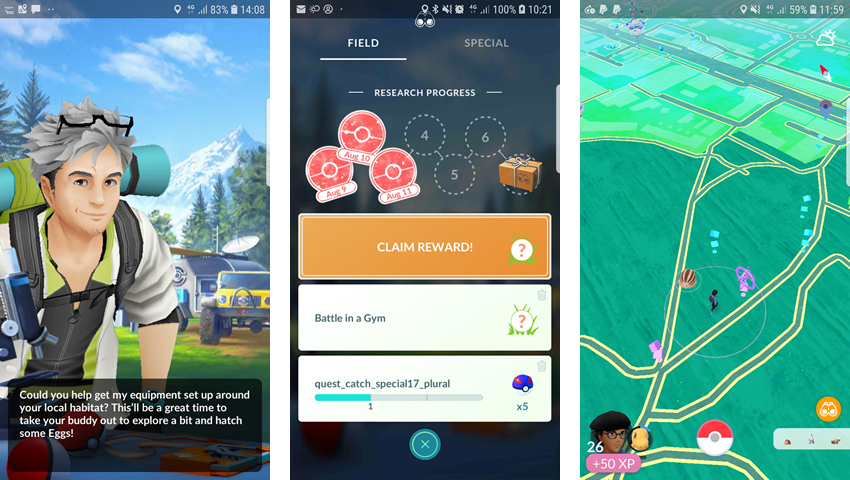
Field Research are essentially missions that you collect when you spin PokeStops. Each PokeStop gets one specific field research mission assigned to it each day, and though you can complete a quest more than once per day you’ll only ever pick up the same mission from any given PokeStop.
You can complete as many field research quests as you, and the rewards for any given quest will vary a little depending on the quest you get. Generally speaking, you’ll want to aim to complete at least one quest per day in order to work towards your research breakthrough, however – but more on that in a moment.
Quests range across all aspects of Pokemon Go and in a sense exist to get players to experience all aspects of the game. Field research quests might ask you to battle in a raid, battle in a gym, hatch Pokemon eggs, catch certain Pokemon types or even spin Pokestops – and these are just a few examples. Sometimes a task will reward you with the items, but other times you’ll be rewarded with a rare Pokemon encounter – field research is the only way to encounter and catch Spinda, for instance – the encounter with a Spinda you need to catch one only comes as the result of a Pokeball-throwing related field research mission. As an aside, these encounters are really useful since Pokemon encountered in this way can’t flee.
The quests and rewards on offer rotate in a monthly manner for the most part, meaning at the end of one month Niantic will retire quests and rewards and replace them with new ones. Sometimes they’ll keep a quest but replace its reward – it really varies from month to month, and often there’s a theme to a month – like how August 2018 features Raikou as a potential reward and a range of other electric Pokemon likewise. With that said, let’s talk about your biggest reward for field research…
Research Breakthroughs in Pokemon Go: earning the big reward
As you can see in the screenshot above – and in game – the field research screen has a series of stamps adding up to seven stamps. You can only earn one stamp per day even if you complete multiple missions – so basically, this series of stamps is designed to last a week. When you reach the seventh day you’ll unlock a Research Breakthrough, represented on the screen by the big wrapped-up parcel from Professor Willow.
Exactly what will be inside these packages varies from month to month alongside the other research bonuses and rewards. The big thing, however, is that every month this tends to feature a Pokemon encounter. These are usually with high-end, rare Pokemon – sometimes even legendary Pokemon – some of the best Pokemon in Pokemon Go. That means you’ll have an unlimited amount of tries to catch them since Pokemon encountered in this way can’t run away. So long as you have patience and Pokeballs, you can keep trying until they’re caught.
Pokemon caught this way will also have naturally high stats – the same sort of stats that you might find on Pokemon encountered as part of raid battles. All in all, this is a great way to catch rare Pokemon. Here’s how past months have gone:
2018 Research Breakthrough rewards in Pokemon Go:

  • April: Moltres (fire-themed research)
  • May: Zapdos (electric-themed research)
  • June: Articuno (ice-themed research)
  • July: Snorlax (Kanto research)
  • August: Raikou (electric-themed research)
  • September:Entei (fire-themed research)

  • September Field Research Rewards: current field research missions and rewards
    As we previously explained, everything around the field research system is on rotation – every month brings around a different set of events with different goals, and we’re going to keep this page current with whatever the current mission set is. For August 2018, this is an electric-themed month with electric-type legendary dog-like beast Raikou as the Breakthrough Reward once you rack up seven days worth of stamps.
    Here’s the quests that you’ll find in your Field Research section during August 2018 – but remember, these quests are rewarded at random from PokeStops, so which you see is entirely down to chance. There’s a lot of quests that give you basic rewards too, like Pokeballs, Stardust and other items – but these are the ones that reward those all-important Pokemon encounters:
    Battle Field Missions & Rewards

  • Battle in a Gym: Mankey encounter
  • Win a Gym Battle: Bulbasaur, Charmander or Squirtle encounter
  • Win 3 Gym Battles: Jynx encounter
  • Win 5 Gym Battles: Machop encounter
  • Use a Super-Effective Charge Attack 7 Times: Electabuzz encounter

  • Catch Field Missions & Rewards

  • Catch a Rattata or Pikachu: Phanpy encounter
  • Catch 5 Fire-type Pokemon: Silver Pinap Berry
  • Catch 10 Pokemon: Magikarp encounter (shiny chance)
  • Use 10 Berries on Pokemon: Growlithe encounter
  • Catch 5 Pokemon with Weather Boost: Vulpix or Poliwag encounter (shiny chance)
  • Catch a Dragon-type Pokemon: Dratini (shiny chance)

  • Raid Field Missions & Rewards

  • Win a level 3 raid or higher: Dratini (shiny chance)

  • Pokeball & Throw Field Missions & Rewards

  • Make a Great Curveball Throw: Spinda encounter
  • Make 5 Nice Throws: Voltorb encounter
  • Mike 3 Great Throws: Gastly encounter
  • Make 3 Great Throws in a row: Onix encounter
  • Make 3 Excellent Throws in a row: Larvitar encounter (shiny chance)

  • Pokemon Management Field Missions & Rewards

  • Power up a Pokemon 3 times: Koffing encounter
  • Power up a Pokemon 5 times: Bulbasaur, Charmander or Squirtle encounter (shiny chance)
  • Transfer 10 Pokemon: Misdreavous encounter
  • Earn 1 Buddy Candy: Numel encounter
  • Send 5 Gifts: Roselia encounter

  • Pokemon Egg Hatching & Evolution Field Missions & Rewards

  • Evolve a Pokemon: Eevee encounter
  • Evolve 5 Fire-type Pokemon: Ninetales encounter
  • Hatch an Egg: Exeggcute encounter
  • Hatch 3 Eggs: Magmar encounter
  • Hatch 5 Eggs: Chansey encounter
  • Special Research Quests & Tasks in Pokemon Go: a quick introduction
    A little swipe across your field research menu will also take you to the Special Research Tasks. These work a little differently, and mercifully for my fingers (and your eyes) don’t require so much assistance or explanation on this page. Still, for avoidance of confusion, let’s talk about them a bit.
    The Special Research Quests are essentially the closest thing Pokemon Go has to a ‘story mode’ – these are fixed quests with fixed objectives and, ultimately, fixed rewards. Each ‘stage’ of the Special Research Quests requires you to complete three missions each with a smaller individual reward in order to unlock the larger reward for that phase of the quest. Once you’ve done that, Professor Willow will then introduce the next phase to you.
    The first Special Research Quest in the game is ‘A Mythical Discovery’, and it’s not much of a spoiler to say it leads to your ability to unlock mythical 151st Pokemon Mew in the game – and now, it can also unlock mythical creature Celebi. Getting there requires completion of a range of missions, however, doing everything from gym battles and raids to catching rarer, difficult-to-locate Pokemon like Ditto. It’s likely this is also how other super-rare ‘final’ legendary Pokemon like Celebi, Jirachi and Deoxys will be unlocked in the future, too.

    Sunday, 2 September 2018

    Competitive Pokemon Explained (Ultra Sun / Moon Edition)

    The 2018 Pokemon World Championships are being held in Nashville, Tennessee this weekend, which means pro-level playing in both the card game (TCG) and the video game (VGC). It's an opportunity for Pokemon fans to see the best strategies players can come up with--the top players in both the trading card game and the video game compete for over $500,000 in prizes, and some of the matches can get pretty intense.
    You can watch all the events now on Pokemon's official World Championships livestream. While the competitive TCG follows most of the usual rules you might be familiar with if you've played recently--and the casters explain complex strategies and unique cards if you aren't up to speed--the competitive video game involves rules and strategies you probably wouldn't use (or even know about) while playing the games normally. This is what you need to know to watch the best Pokemon video game playing you'll see all year.
    No Caption ProvidedThe Basics
    The official Pokemon video game championships are known as the VGC, and the 2018 series uses Pokemon Ultra Sun and Ultra Moon. The rules for this year include:
  • A player’s team cannot contain two Pokémon with the same National Pokédex number.
  • Pokémon may only use moves that have been learned through normal gameplay or from an official Pokémon event or promotion.
  • Pokémon may have Hidden Abilities.
  • Pokémon may use Z-Moves.
  • Pokémon must have the black clover on their summary screen. [This is to check for hacked Pokemon.]
  • Pokémon above and below Lv. 50 are permitted, but will be auto-leveled to Lv. 50 during battle.
  • Ash-Greninja is prohibited from use.
  • When Pokémon have a regional variant, either form may be used.
  • Additionally, many legendary and mythical Pokemon are prohibited. Notably, Kyogre, Groudon, and Rayquaza are banned--a welcome ban for those who were tired of their weather effects and the meta-game that sprung up around them in previous years. Mega Evolution is also back after last year's omission.
    All competitive battles are double battles, meaning each player has two Pokemon out on the field at one time. Additionally, they're required to register a "battle team" of four to six Pokemon at the beginning of any given VGC event and can't change it, so they have to come prepared.
    Before every battle, each player is given a 90-second preview of their opponent's battle team. Based on that preview, they then pick the four Pokemon from their team that they think will best counter their opponent's Pokemon. If all your Pokemon faint, you lose. Ties at the end of the time limit are broken based on how much HP each player's Pokemon have left.
    Before The Battle
    Much of what goes into competitive Pokemon happens before the battles themselves. Players spend a lot of time crafting teams that work well together--Pokemon that can effectively combo off of each other, counter popular Pokemon, and represent a variety of types and purposes. Rather than just use a bunch of strong attacks, VGC battles involve a lot of status and support moves that enhance the performance of already strong Pokemon. Usually, teams will be a mix of strong offensive Pokemon and support Pokemon with less-than-stellar stats but access to important moves or abilities.
    Trick RoomTrick Room
    For example, the move Trick Room reverses the priority on the field for five turns, meaning the slowest Pokemon move first. Attacking first can make or break a battle, and it's a great option for Pokemon with high attack or special attack stats but poor speed. If you're going to use Trick Room, you'd want most of the Pokemon you use to be on the slower side so that the team is compatible. On top of that, you wouldn't want your main attacker to use Trick Room; you'd teach Trick Room to a support Pokemon instead, since its purpose is to provide setups for stronger Pokemon to capitalize on.
    In order to build these teams, pro players look at semi-hidden stats called individual values (IVs). IVs are assigned to Pokemon when they're caught or hatched from an egg, and they determine the max growth of each of their stats (HP, attack, defense, special attack, special defense, and speed). Players breed Pokemon to get the IVs that will work best for them, usually the highest IV in most stats. For the Trick Room example, though, breeding a Pokemon with the lowest possible speed IV would help ensure that it will be the slowest Pokemon on the field and therefore benefit from the effects of Trick Room.
    Players also breed Pokemon to get specific natures, which increase the growth of one stat and decrease the growth of another. For the slow Pokemon, you might want a Brave nature, which increases attack and lowers speed. That way, you're making sure this Pokemon is really slow, but you're also giving it a boost so it can hit harder.
    via eBayvia eBayvia eBay
    When breeding, players also look for the right ability--most Pokemon have two or three possible abilities, each with different benefits. Whimsicott, for example, is a support Pokemon that has access to Trick Room but a high speed stat, which normally wouldn't be ideal on a Trick Room team. However, one of its abilities is Prankster, which gives non-damaging moves priority. When up against a similarly slow team, that priority can often allow it to move first even under Trick Room, and it can then continue to provide support with its wide pool of non-damaging and status moves. You might decide that's too risky, though, and opt for Tailwind as a form of speed control instead--rather than reversing priority, it just increases priority on your side of the field.
    Finally, after breeding the perfect Pokemon, players train them with a focus on effort values (EVs). You can get EVs in several ways, including battling, using items, and training in Poke Pelago. A limited number of EVs can be "invested" in a Pokemon's stats to increase growth for that stat. For the slow attacker, you'd invest the maximum EVs in its attack stat while making sure it doesn't have any EVs in speed.
    After a pro player has caught, bred, and trained all their Pokemon, it's time to practice with that team and tweak it until the competition!
    Watching Battles
    Once you understand everything that goes into building a team, it becomes a lot easier to follow battles. Competitors aren't just trying to hit the hardest; they're trying to gain supremacy over the field in a number of ways, including speed control, weather, and generally making it difficult for the other player to execute their desired strategy. The fight for control is what makes championship-level battles so exciting.
    This year's competitive scene is a combination of what we've seen in the last few years. Mega Evolution is back this year, and that makes for some hard-hitting, high-powered Pokemon. Also returning this year is Landorus, popular in previous years as an Intimidate user (an ability that lowers opponents' attack), and the Alolan Ultra Beasts, which can fit various roles on a team depending on what the player is using.
    Legendaries Tapu Koko, Tapu Lele, Tapu Bulu, and Tapu Fini are also back with their terrain-changing abilities, which are activated when they enter the field. Each of the four types of terrain (electric, grassy, misty, and psychic) have certain effects. For example, Electric Terrain increases the power of electric-type moves and prevents sleep, and the popular Tapu Koko's Electric Surge ability introduces it. One way to counter it would be to send out another Tapu and introduce a different terrain. You'll definitely see plenty of Tapus when watching competitive Ultra Sun and Moon, so if you see a player switching their Tapu in and out, they're most likely trying to get the upper hand on the terrain.
    No Caption ProvidedNo Caption Provided
    Going back to the speed control example, someone using Whimsicott would lead with it in order to set up Trick Room or Tailwind and use Whimsicott's other support moves to disrupt the opponent's plan. VGC players often run Encore on Whimsicott, for example, which causes the target to repeat the last move it used for three turns. If the player can predict what that Pokemon might use--something like Protect, which isn't reliable when used multiple turns in a row--Encore can seriously hinder the opposing player's ability to do any damage or impose a strategy of their own.
    At the 2016 World Championships, there was one battle toward the end of the weekend between two identical teams. This isn't uncommon in the VGC, in which only a select number of the 700-plus eligible Pokemon are considered "viable." Knowing how to effectively play those Pokemon gives players the edge, and throwing in a curveball Pokemon with a unique use or running uncommon moves on common Pokemon is another way to avoid being predictable. This year, the combination of a few previous years' metas makes for interesting team combinations.
    When watching the official Pokemon VGC streams, you'll get some context from commentators about what's going on and which Pokemon are surprising or especially effective. For more details on which teams are most successful and why, you can check out the official Pokemon website. If you're interested in trying out competitive battles for yourself, Smogon is a great resource for movesets and team tips.
    The Pokemon World Championships run until midday Sunday, August 26.

    'Some people call me the Pokemon master': Oak Forest teen wins video game world championship title

    Unfortunately, our website is currently unavailable in most European countries. We are engaged on the issue and committed to looking at options that support our full range of digital offerings to the EU market. We continue to identify technical compliance solutions that will provide all readers with our award-winning journalism.

    Feature: This Year's Pokémon World Championships Showcased The Positivity Of The Games Community

    Since 2004, the Pokémon World Championships have been a place where the best Pokémon players from all over the world have come to see which player is the very best, like no-one ever was. This year, the event took place in the Music City itself: Nashville, Tennessee.
    This year, to go with the location, it had a special motif to follow the whole music theme. The stage was decked out like a country music venue with the sides set out like Broadway in Nashville. There were decorations of many musical-themed Pokémon all around the arena; it was truly the greatest stage that has been done at a Pokémon World Championships.
    What are the Pokémon World Championships?
    Over the past year, players from the world of the Pokémon Video Games and Pokémon Trading Card Games have been competing in competitions around the world hoping to obtain enough points to earn an invite to the World Championships, with the top players in each region getting an invite to skip the first day. The event is a 3-day long tournament, with players who received an invite having to go through a day of Swiss Rounds, where they have to play through 6 or more battles to then be ranked based on performance. Based on that, the players who achieve a certain rating will then move onto Day 2 where there’s a second set of Swiss Rounds before the Top 8 players are put into Top Cut until it’s down to the Top 2 on the finals.
    Fighting game Pokkén Tournament does it a different way, with players going on a Double Elimination Bracket where, if they lose, they have more chances of going through the loser’s bracket to return to the eventual finals. Pokkén Tournament ran on Pokkén Tournament DX's foundation and started off with a Last Chance Qualifier on the Friday, where any player who chose to enter had a chance to play through to gain a place on the actual Pokkén Tournament DX Championships on Day 2. From there, the top players who earned a place throughout the year faced off to become World Champion.
    Special Merchandise
    As with every year, a special Pokémon Center pop-up store was opened at the World Championships. This sold a myriad of official Pokémon Center merchandise but also included a number of unique Nashville-themed items, including a Pikachu plush, playmats, deck boxes, card sleeves, T-Shirts, hoodies and bags.
    However, to top that off, all players who earned themselves an invite got a special competitor's bag. This contained various other merchandise and exclusive variations of the merchandise in the store. They got an exclusive accessory pouch, screen cleaner, bag and even 5 guitar picks! Unfortunately, we were not able to get hold of the competitor’s bag this year. Boo.
    This is what we came away with this year. Don't be jelly.
    The Announcements
    A Pokémon World Championships would not be the same without special announcements, and this year had plenty. While there was sadly no news for the upcoming core games Pokémon Let’s Go, Pikachu! & Let’s Go, Eevee!, The Pokémon Company didn’t hold back on reveals. It started with the reveal of Tag Team GX cards, a new kind of Pokémon GX card that combines two Pokémon and does a lot of damage, but at the cost of 3 Prize Cards when defeated.
    Next up was the forthcoming Pokémon: Detective Pikachu movie. Director Rob Letterman and stars Justice Smith and Kathryn Newton came out onto the stage to show off the logo of the upcoming movie as well as getting some audience participation to do some cheers for Pikachu and Charizard, which will be in the movie upon its release.
    Finally, during the Saturday, the ruleset for VGC 2019 was revealed, to a mixed response. When it was announced that the ruleset would be GS Cup on Ultra Sun & Ultra Moon (where players can use 2 Restricted Pokémon such as Mewtwo, Necrozma and Zygarde in their team), there were many audible groans, but for the first time ever this circuit will be separated into three. The first Sun Series will ban all Mega Evolutions and Z-Crystals. The second series, Moon Series, will ban all Mega Evolutions while the final series, Ultra Series, allows everything. This idea was much appreciated by the VGC community and should make the next year very interesting.
    What was there to do?
    If you weren’t invited, you could come as a spectator and there was even more to do there than last year. Starting off, there was a massive trade corner for players to go to trade whatever they wish. From cards to sleeves and even Regional Pokémon in Pokémon GO, the trade section was always full.
    There was also, once again, many side events but unfortunately, they were less varied than last year. There were the standard VGC and TCG pickup events where when 8 people had registered, they’d enter a mini-tournament. For TCG, there was also a sealed event that acts like a pre-release tournament where you go in with no cards and have to make a 40 card deck, and a VGC Multi Battle event. There was also the Nashville Open, a huge competition for players who couldn’t win an invite to Worlds and those who had dropped out after Day 1, which allowed for players to win Championship Points towards next year’s World Championships.
    After last year had a display of the Kanto Starters made by Mega Construx, this year continued that and had three large statues of Squirtle, Wartortle and Blastoise to check out, and they were really impressive but the most striking element of the Mega Construx both was a huge diorama of all their Pokémon merchandise. Whoever created must be very talented; the attention to detail was mind-blowing.
    This year, there was a lovely small retro corner where several Nintendo 64 and GameCube consoles were set up to play the classics such as Pokémon Snap, Pokémon Puzzle League, Pokémon Stadium, Pokémon Stadium 2 and Pokémon Colosseum. It was fun to go back and play people from around the world at the classic mini-games in Pokémon Stadium, that's for sure.
    Finally, there was one more major element at the event: Pokémon Let’s Go, Pikachu! & Let’s Go, Eevee! were playable at the event. The demo was the same as the one at E3 in June and PAX West in August, and featured Viridian Forest. It was a good fun demo and I even managed to get a Shiny Oddish as my first encounter. This was, quite obviously, the biggest thing to do away from the tournament and always had a queue of over an hour to play.
    The Matches
    Of course, there were world-class matches for all three games that helped determine the winners which you can find on the official YouTube channel. These matches really helped show the best of the best.
    Pokkén Tournament DX’s finals were on the Saturday and were amongst the most hyped finals we had ever seen. Once again, many players returned from previous years but this year it was the newer players who came out more triumphant as the old guard dropped out of the bracket early on. In the final, ThankSwalot and Tarutaro battled for glory and it looked like it was going to go to Tarutaro as he took a stunning lead and even reset the bracket after coming up through the Loser’s Bracket, but eventually, Thankswalot managed to turn the tide and became the third Pokkén Tournament World Champion.
    The Pokémon Trading Card Game was equally as tense. This was the final competition before the format rotated and so many core cards to decks would no longer be usable. Cards such as N, Puzzle of Time and many others wouldn’t be usable after this competition, so it's truly the final time we’d see these cards. Many of the standard decks could be seen during the finals, such as Buzzwole/Lycanroc and Garbotoxin Garbodor decks, with some matches even being mirror matches. However, the contests were fairly clearcut with one clear winner.
    Juniors: Naohito Inoue
    Seniors: Magnus Pedersen
    Masters: Robin Schulz
    The Video Game tournament was where things were definitely unique. Despite constant complaints of the format not being innovative enough, this year the top cut for VGC had the most diverse teams that we had seen. With it being the first year of Ultra Sun & Ultra Moon and the first year of National Pokédex, it had never been more diverse.
    The Juniors match was a stunning contest that really showed the raw power of such a classic combo. With the duo of Whimsicott and Terrakion making a return from long ago, Won Lee managed to completely dominate Sota Tamemasa’s team, stopping the strategy in the tracks with the combination of Beat Up Whimsicott and Terrakion’s Z-Move Continental Crush preventing Sota from setting up the Trick Room that his team sorely needed.
    The Seniors match was a lot closer, with some more conventional strategies coming to light. With much switching of Landorus and Incineroar, James Evans was able to get off continual Intimidates, lowering the Attack stat of Bram De Jonge’s team, which was unfortunately very physically-focused; this eventually let James Evans take the title for the United States.
    The Masters division as equally as competitive with Emilio Forbes of the US facing against Paul Ruiz from Ecuador; once again, these were not the more conventional VGC teams you would see. Emilio was using Mega Gengar and Latias while Paul was using Mega Salamence, Gastrodon and Kartana. Both teams continued the trend in VGC of Intimidate but eventually, Paul managed to come out triumphant and became the first ever World Champion from Latin America.
    Juniors: Wonn Lee
    Seniors: James Evans
    Masters: Paul Ruiz
    Until Next Year...
    This was the last World Championships with so many staples in the battles and at the end, they announced that the Pokémon World Championships would be returning to Washington D.C., where it was held back in 2014.
    The World Championships may be fun to watch from home, but they’re much more fun to attend. You’ll get to meet so many like-minded players who share the same passion you do. The community is always there to help each other out, and have a laugh. Animosity is so rare at the event, which is refreshing in this day and age - especially in light of tragic recent events which have forced many organisers to reassess security and have also harmed the perception of the games industry in the media. 
    If you manage to make it to Washington D.C.'s World Championships next year, you’re bound to have a lot of fun. They might even restore your battered belief in the power of video games (and their associated pastimes) to bring people together.

    Pokemon GO: How to Evolve Eevee Into Umbreon Without the Name Trick

    Pokemon GO‘s Celebi Special Research quest is now live, and it has a variety of objectives that players have to complete if they want to add the mythical Pokemon to their collection. There are a couple of objectives that revolve around Eevee, with one asking players to evolve Eevee into Espeon, and another asking them to evolve Eevee into Umbreon.
    Like other Eevee evolutions, there is a name trick that’s commonly used in Pokemon GO to control Eevee’s evolution. For Umbreon, players need to give Eevee the nickname Tamao and evolve it. However, the name trick only uses the first time, so some players may be wondering of another method they can use to evolve Eevee into Umbreon.
    To evolve Eevee into Umbreon without using the name trick, players first need to make Eevee their buddy Pokemon. After that, players need to walk a total of 10km with Eevee as their buddy, and then wait for it to be night time. Make sure that it’s night time in Pokemon GO, as in the night sky in the game world is dark, and then evolve the Eevee that’s assigned as your buddy Pokemon. If all the requirements are met, then that Eevee should evolve into Umbreon.
    pokemon go eevee evolve espeon umbreon guide
    Players won’t run into the step to evolve Eevee into Umbreon until they’ve completed the first four steps to the Celebi Special Research quest. Prior to that, they will have to evolve Eevee into Espeon, and as one might imagine, the same exact method will work, except instead of evolving Eevee at night, players need to do it during the day.
    Another objective for this step in the Celebi Special Research quest actually asks players to walk with Eevee as their buddy for 10km anyway, so players can complete two objectives at once. Then all they’ll need to do to complete the step is trade a Pokemon, which should be as easy as finding a friend nearby willing to trade.
    Now that players know that they can evolve Eevee into Umbreon without using the name trick, what they need to do in order to complete the Celebi Special Research should be more apparent.
    Pokemon GO is out now for iOS and Android mobile devices.

    Competitive Pokemon Explained (Ultra Sun / Moon Edition)

    The 2018 Pokemon World Championships are being held in Nashville, Tennessee this weekend, which means pro-level playing in both the card game (TCG) and the video game (VGC). It's an opportunity for Pokemon fans to see the best strategies players can come up with--the top players in both the trading card game and the video game compete for over $500,000 in prizes, and some of the matches can get pretty intense.
    You can watch all the events now on Pokemon's official World Championships livestream. While the competitive TCG follows most of the usual rules you might be familiar with if you've played recently--and the casters explain complex strategies and unique cards if you aren't up to speed--the competitive video game involves rules and strategies you probably wouldn't use (or even know about) while playing the games normally. This is what you need to know to watch the best Pokemon video game playing you'll see all year.
    No Caption ProvidedThe Basics
    The official Pokemon video game championships are known as the VGC, and the 2018 series uses Pokemon Ultra Sun and Ultra Moon. The rules for this year include:
  • A player’s team cannot contain two Pokémon with the same National Pokédex number.
  • Pokémon may only use moves that have been learned through normal gameplay or from an official Pokémon event or promotion.
  • Pokémon may have Hidden Abilities.
  • Pokémon may use Z-Moves.
  • Pokémon must have the black clover on their summary screen. [This is to check for hacked Pokemon.]
  • Pokémon above and below Lv. 50 are permitted, but will be auto-leveled to Lv. 50 during battle.
  • Ash-Greninja is prohibited from use.
  • When Pokémon have a regional variant, either form may be used.
  • Additionally, many legendary and mythical Pokemon are prohibited. Notably, Kyogre, Groudon, and Rayquaza are banned--a welcome ban for those who were tired of their weather effects and the meta-game that sprung up around them in previous years. Mega Evolution is also back after last year's omission.
    All competitive battles are double battles, meaning each player has two Pokemon out on the field at one time. Additionally, they're required to register a "battle team" of four to six Pokemon at the beginning of any given VGC event and can't change it, so they have to come prepared.
    Before every battle, each player is given a 90-second preview of their opponent's battle team. Based on that preview, they then pick the four Pokemon from their team that they think will best counter their opponent's Pokemon. If all your Pokemon faint, you lose. Ties at the end of the time limit are broken based on how much HP each player's Pokemon have left.
    Before The Battle
    Much of what goes into competitive Pokemon happens before the battles themselves. Players spend a lot of time crafting teams that work well together--Pokemon that can effectively combo off of each other, counter popular Pokemon, and represent a variety of types and purposes. Rather than just use a bunch of strong attacks, VGC battles involve a lot of status and support moves that enhance the performance of already strong Pokemon. Usually, teams will be a mix of strong offensive Pokemon and support Pokemon with less-than-stellar stats but access to important moves or abilities.
    Trick RoomTrick Room
    For example, the move Trick Room reverses the priority on the field for five turns, meaning the slowest Pokemon move first. Attacking first can make or break a battle, and it's a great option for Pokemon with high attack or special attack stats but poor speed. If you're going to use Trick Room, you'd want most of the Pokemon you use to be on the slower side so that the team is compatible. On top of that, you wouldn't want your main attacker to use Trick Room; you'd teach Trick Room to a support Pokemon instead, since its purpose is to provide setups for stronger Pokemon to capitalize on.
    In order to build these teams, pro players look at semi-hidden stats called individual values (IVs). IVs are assigned to Pokemon when they're caught or hatched from an egg, and they determine the max growth of each of their stats (HP, attack, defense, special attack, special defense, and speed). Players breed Pokemon to get the IVs that will work best for them, usually the highest IV in most stats. For the Trick Room example, though, breeding a Pokemon with the lowest possible speed IV would help ensure that it will be the slowest Pokemon on the field and therefore benefit from the effects of Trick Room.
    Players also breed Pokemon to get specific natures, which increase the growth of one stat and decrease the growth of another. For the slow Pokemon, you might want a Brave nature, which increases attack and lowers speed. That way, you're making sure this Pokemon is really slow, but you're also giving it a boost so it can hit harder.
    via eBayvia eBayvia eBay
    When breeding, players also look for the right ability--most Pokemon have two or three possible abilities, each with different benefits. Whimsicott, for example, is a support Pokemon that has access to Trick Room but a high speed stat, which normally wouldn't be ideal on a Trick Room team. However, one of its abilities is Prankster, which gives non-damaging moves priority. When up against a similarly slow team, that priority can often allow it to move first even under Trick Room, and it can then continue to provide support with its wide pool of non-damaging and status moves. You might decide that's too risky, though, and opt for Tailwind as a form of speed control instead--rather than reversing priority, it just increases priority on your side of the field.
    Finally, after breeding the perfect Pokemon, players train them with a focus on effort values (EVs). You can get EVs in several ways, including battling, using items, and training in Poke Pelago. A limited number of EVs can be "invested" in a Pokemon's stats to increase growth for that stat. For the slow attacker, you'd invest the maximum EVs in its attack stat while making sure it doesn't have any EVs in speed.
    After a pro player has caught, bred, and trained all their Pokemon, it's time to practice with that team and tweak it until the competition!
    Watching Battles
    Once you understand everything that goes into building a team, it becomes a lot easier to follow battles. Competitors aren't just trying to hit the hardest; they're trying to gain supremacy over the field in a number of ways, including speed control, weather, and generally making it difficult for the other player to execute their desired strategy. The fight for control is what makes championship-level battles so exciting.
    This year's competitive scene is a combination of what we've seen in the last few years. Mega Evolution is back this year, and that makes for some hard-hitting, high-powered Pokemon. Also returning this year is Landorus, popular in previous years as an Intimidate user (an ability that lowers opponents' attack), and the Alolan Ultra Beasts, which can fit various roles on a team depending on what the player is using.
    Legendaries Tapu Koko, Tapu Lele, Tapu Bulu, and Tapu Fini are also back with their terrain-changing abilities, which are activated when they enter the field. Each of the four types of terrain (electric, grassy, misty, and psychic) have certain effects. For example, Electric Terrain increases the power of electric-type moves and prevents sleep, and the popular Tapu Koko's Electric Surge ability introduces it. One way to counter it would be to send out another Tapu and introduce a different terrain. You'll definitely see plenty of Tapus when watching competitive Ultra Sun and Moon, so if you see a player switching their Tapu in and out, they're most likely trying to get the upper hand on the terrain.
    No Caption ProvidedNo Caption Provided
    Going back to the speed control example, someone using Whimsicott would lead with it in order to set up Trick Room or Tailwind and use Whimsicott's other support moves to disrupt the opponent's plan. VGC players often run Encore on Whimsicott, for example, which causes the target to repeat the last move it used for three turns. If the player can predict what that Pokemon might use--something like Protect, which isn't reliable when used multiple turns in a row--Encore can seriously hinder the opposing player's ability to do any damage or impose a strategy of their own.
    At the 2016 World Championships, there was one battle toward the end of the weekend between two identical teams. This isn't uncommon in the VGC, in which only a select number of the 700-plus eligible Pokemon are considered "viable." Knowing how to effectively play those Pokemon gives players the edge, and throwing in a curveball Pokemon with a unique use or running uncommon moves on common Pokemon is another way to avoid being predictable. This year, the combination of a few previous years' metas makes for interesting team combinations.
    When watching the official Pokemon VGC streams, you'll get some context from commentators about what's going on and which Pokemon are surprising or especially effective. For more details on which teams are most successful and why, you can check out the official Pokemon website. If you're interested in trying out competitive battles for yourself, Smogon is a great resource for movesets and team tips.
    The Pokemon World Championships run until midday Sunday, August 26.

    Jurassic World Alive Tips & Tricks – Dinosaur DNA by the dartful

    Pokemon Go might still be on top of the augmented reality game throne, but for all the dinosaur lovers in the world there’s another great option. Jurassic World Alive borrows heavily from the hit Niantic title, but with the unbeatable draw of cool dinosaurs.
    Since it’s been out for a few months now, players have already discovered a wealth of tips and tricks for Jurassic World Alive. We’ve collected them into this neat little list that’s sure to grow your dinosaur collection.
    The main element of Jurassic World Alive is finding and collecting dinosaur DNA by launching darts from your handy drone. It takes a while to get used to it, but these tips should help you get started.
    Take your time on the first shot
    Since your time is limited by your drone’s battery each time you launch it after a dinosaur, you might be tempted to start shooting right away. However, no matter how long you hold your first shot, the battery doesn’t start draining until you release.
    The longer you hold your shot, the larger the target grows
    On top of that, the target grows larger the longer you wait. This makes it much easier to land a direct hit on your first shot, so really you have no excuse for missing.
    Do be aware that although the dinosaurs won’t start running until you take your first shot, some of them do sway back and forth slightly. This is especially true if it happens to spawn on the tail of a larger beast.
    Adjust your aim with your target’s speed
    As you fire darts and land direct hits, your target will move faster and faster. For the first three shots, aim just outside of the center target, and more often than not you’ll land a direct hit.
    After that, the dinosaur will gain speed and you’ll have to aim just outside the larger circle. It will also begin to turn while speeding up. Your best bet is to simply wait for it to finish turning before taking your next shot.
    Know the target spawn locations
    Depending on the type and rarity of the dinosaur in your sights, target locations will spawn in different locations. For common dinosaurs, there are only two potential target locations, and they’ll cycle back and forth. This makes it easy to predict where to aim your next shot.
    15 best free Android games of 2018!
    We all know that free Android games aren't always free these days, but many of them are very close if you have a little patience. Most Freemium bottlenecks occur when players get impatient and waiting …
    Epic types, on the other hand, have four potential target spawn locations, and they won’t follow any predictable pattern. You’ll just have to wait for the next target to appear and adjust your aim accordingly.
    The most difficult targets to hit are always the ones on the head or tail. Not only are they small, but they also sway considerably. Sometimes it’s best to get them out of the way quickly rather than try to get a direct hit. The next target is sure to be easier to hit.
    Practice makes perfect
    Like anything, your dinosaur hunting… I mean DNA gathering skills will improve with time. Don’t worry if you struggle at first. Just take your time aiming and you’ll get better naturally.
    The good news is that as you level up, the amount of DNA you get per shot also goes up. Rest assured that although the going might be tough early, you’ll be rolling in dino-DNA in no time.
    Once you’ve collected some powerful dinosaurs, it’s time to take them into battle. Battles give great rewards, and they don’t require you to walk around to get them.
    But obviously, you have to win the battles in order to get anything at all. On that note, we have a few tips and tricks for battling in Jurassic World Alive.
    Level up a fast dinosaur
    There are three major stats in Jurassic World alive. They are health, damage, and speed. The best strategy for winning battles early on is sticking with something fast and leveling it as quickly as possible.
    A speedy dinosaur like the velociraptor will take down foes before they have a chance to hit back
    The reason for this is that with enough speed and attack, they can take down any foe before they even get a chance to attack. High health armored dinosaurs are the only thing that can survive the onslaught, but they won’t do much damage before you finish them off. Plus, most opponents will lead with dinosaurs with high damage stats.
    One easy to find speedy dinosaur is the velociraptor. Make sure that it’s as high level as possible, since any opponent with a higher level velociraptor will one shot you back into… well, the Jurassic era.
    Switch dinosaurs before they’re defeated
    This will sound obvious to anyone who’s played any Pokemon games, but switching your weakened dinosaurs out before they are finished off is often the only way to prevent defeat.
    10 best augmented reality games and AR games for Android
    Augmented reality gaming is still a new concept. The first seriously popular AR game on mobile were Ingress and Pokemon Go. Before that it was mostly proof of concept games and stuff like that. It …
    In Jurassic World Alive, you just need to take down three of your opponent’s dinosaurs to win. This means that one will always be left standing. If they never leave the bench, you’re effectively fighting a man down.
    If your current dinosaur is one hit away from a knockout, switch them out. Make sure you switch to something tanky that can eat the initial hit, which takes us to our final tip for battling in Jurassic World Alive.
    Keep high health, high armor dinosaurs on your team
    As stated above, high health and armor dinosaurs are the best counter to high speed dinosaurs like the velociraptor. Keeping at least one on your squad is the best way to prevent getting swept by a slightly higher level opponent.
    Sometimes battles are essentially a pre-historic game of rock paper scissors
    In most battles, your high level velociraptor will be able to take down one to two dinosaurs before being defeated. This means you can coast to victory with beefier team members worry-free.
    Be aware, however, that armored dinosaurs are weak against hard hitting foes, which are in turn weak against fast dinosaurs. It’s essentially a pre-historic game of rock paper scissors.
    That’s all for this list of Jurassic World Alive tips and tricks. Have any more tips to add to the list? Let us know in the comments below!